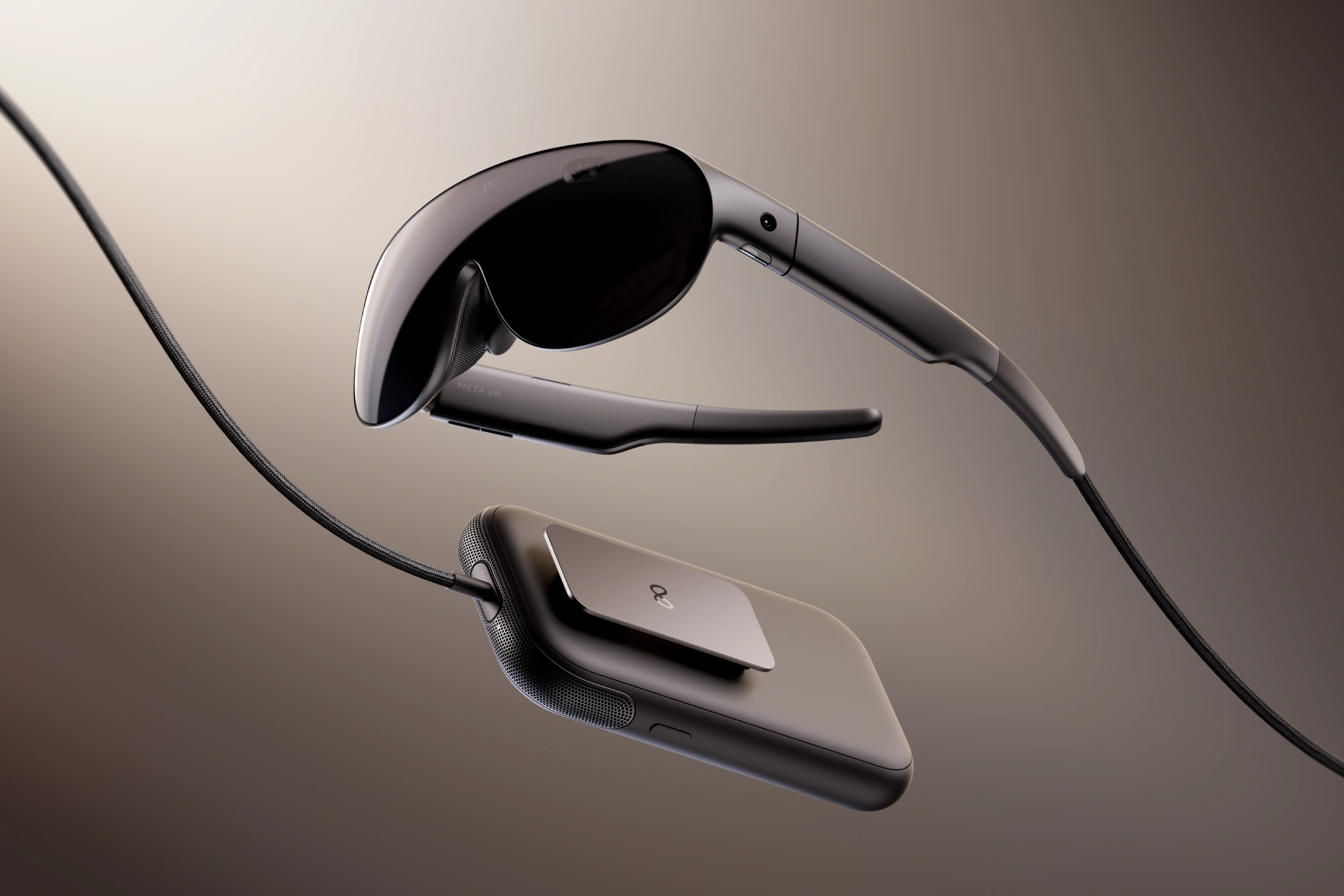
Meta announced a new category of VR hardware at Connect 2026: glasses that weigh around 100 grams by offloading their battery and processing power to a separate handheld puck, priced at $1,299.99 ahead of a spring 2027 launch.
Key Facts
- Weight: approximately 100 grams
- Compute and battery moved to an external puck, connected to the glasses
- Uses microdisplays instead of the bulkier screens found in standard VR headsets
- Runs Meta’s existing Quest software ecosystem
- Price: $1,299.99
- Target launch window: spring 2027
What Was Announced
At its Connect 2026 event, Meta introduced VR glasses designed to look and feel far closer to ordinary eyewear than the headsets that have defined virtual reality so far. The company’s own announcement frames the device as part of a broader hardware showcase spanning VR, AI glasses and its Muse assistant.
The Details
The headline engineering choice is the separation of compute and battery into an external puck, which connects to the glasses and handles the processing load that would otherwise require a much bulkier, heavier headset. Meta paired this with microdisplays — smaller, more efficient screens than those used in current Quest headsets — to keep the glasses themselves light enough for extended wear.
Despite the new form factor, the glasses run the same Quest software Meta already ships on its headset line, meaning existing VR content and experiences are expected to carry over rather than requiring an entirely new platform. Gamedeveloper.com, covering the announcement, notes that the external puck is central to how Meta achieved the roughly 100-gram weight target.
Why It Matters
VR headsets have struggled to move beyond gaming and niche enterprise use partly because of their bulk. A lighter, glasses-like form factor that still runs a mature software ecosystem could make VR more practical for everyday use — media consumption, short work sessions, or social features — rather than dedicated, headset-only sessions.
What Happens Next
Meta has set a spring 2027 target for launch at a $1,299.99 price point, positioning it as a premium device rather than a mass-market product out of the gate. Between now and then, expect more detail on battery life, field of view and how seamlessly the puck-based architecture performs compared with a fully self-contained headset.
Sources: Meta Connect 2026 news, Game Developer